

Zeigarnik!
Kids don’t just need less screen time. They need screen time that actually ends.
Endless scroll keeps kids waiting for the next thing. Wanderwing gives them something better: a quick game with a real endpoint. They play, celebrate, save what they noticed, and move on.
You know that screen-time meltdown?
From the outside it looks like they’ve been passively doing the same thing for an hour. You agreed on the time limit, you gave a warning, and now you’ve said “Okay, time to put your screen down.”
You did everything right. You agreed on the boundaries. You gave a warning. So, why is this child acting like you just unplugged Toy Story 3 when the the toys are holding hands in the incinerator?
Well, because, you kind of did.
For most of internet history, the web still had edges. You read the page. You checked the catalog. You finished the game. You reached the bottom.
Then in 2006, Facebook launched the News Feed. In 2008, the App Store put infinite little dopamine machines in our pockets. And in less than 20 years, childhood moved from screens you could finish to feeds that never say, “The End.” Kids are growing up on digital products with no completion loop.
Endless scroll keeps the brain in unresolved anticipation. This is what parents are up against. This is why your timers, and your warnings, and automatic screen shut offs are still causing a power struggle in your family.
We are asking kids to practice stopping inside products that were designed to never stop.
For years, parents have been told to focus on screen time — how many minutes, how many hours, what time of day.
But most of us are living the harder question:
Why is stopping so hard?
The answer may not be your rule.
It may not be your child being “dramatic.”
It may be that endless scroll never gave their brain a stopping point.
The Science: The brain wants an ending
There is a psychology term for this: the Zeigarnik Effect.
You do not need to remember the name. You already know the feeling.
It’s the same feeling you had watching “Who Shot Mr. Burns?,” when Ross said Rachel’s name at the alter on Friends, or when they found the hatch on Lost. It’s the feeling of a cliffhanger.
The feeling of getting interrupted mid-thought.
The feeling of needing to know what happens next.
Our brains tend to hold onto unfinished things.
That is part of why endless scroll is so powerful. It keeps creating tiny unfinished moments before the last one ever has a chance to resolve.
Your child’s brain keeps asking:
What’s next?
What did I miss?
What happens now?
What if the next one is better?
Then the parent says: Time’s up! And now everyone is upset and no one can explain why.
Why “screen completion” matters more than we think.
For a long time, the conversation around kids and screens has focused on screen time.
But a healthier question may be:
Did this screen give my child a chance to close a loop? OR Did this screen set off a cliff hanger response in their brain?
Because screen time with no ending can feel like being pulled away.
Screen time with an endpoint gives kids a different experience.
They can say:
I played something.
I finished it.
I got a little win.
I saved what I noticed.
Now I can move on.
That is why Wanderwing is built around a simple rhythm:
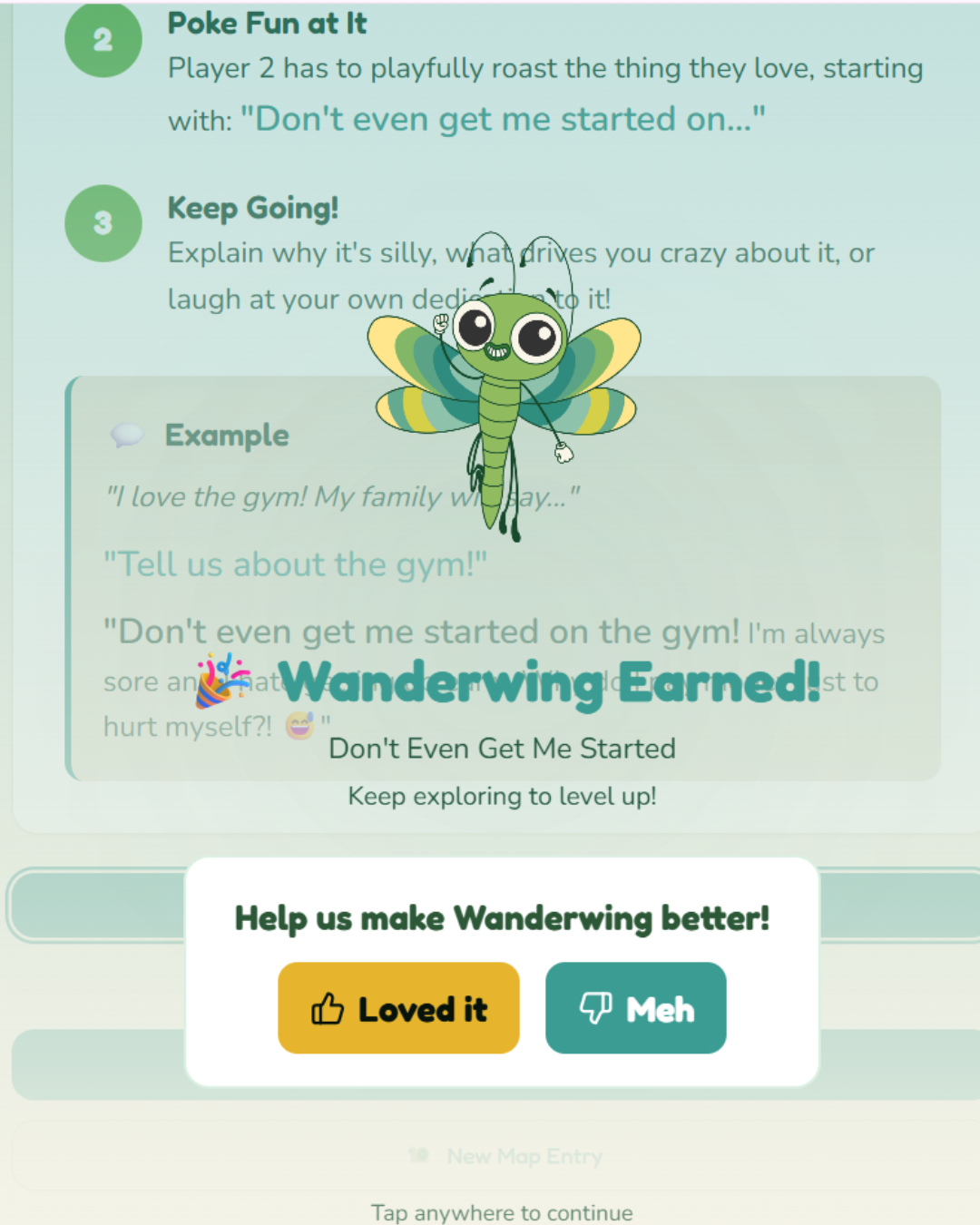
Play. Celebrate. Save. Move on.
Not scroll forever.
Not auto-play into the next thing.
Not get pulled along by an algorithm.
A quick game.
A little celebration.
A place to save it.
Then on with the day.
Parent guide: What to try at home
You do not have to overhaul your whole family system today. Start with one shift:
Before screen time starts, ask: “Where does this end?”
Try this:
Instead of: “You have 20 minutes.”
Try: “Pick one thing you can finish.”
Instead of: “Stop right now.”
Try: “Finish this part, then we’re moving on.”
Instead of: “No more screens ever.”
Try: “Let’s choose something that has an ending.”
Instead of: endless scroll
Try: a quick Wanderwing game prompt
Kids are learning how to start, finish, save, and move on.
And honestly? So are we.
Because this is new for all of us.
The new screen habit parents can teach: Screen Balance
Because kids do not just need less screen time. They need a full story, a beginning, a middle, an end, and dopamine from completion not from the next thing they might see. That is screen balance.
Not forcing regulation with a timer slapped on top of an endless feed. When screen time has an ending, stopping becomes a skill they can practice — not a fight they have to lose.
A healthy screen habit sounds like this:
I know what I’m playing.
I know when I’m finished.
I get to celebrate the win.
I can save what I noticed.
I can move on.
That is what Wanderwing helps kids practice.
Not because screens are bad.
Because endless scroll is hard to leave.
And kids deserve screen moments that give them a better way out.